Three thousand years of history in 83 km² of Mediterranean. Romans, Arabs, pirates, republican prisoners, hippies and the best blue in the world.
With barely 83 km² and about 12,000 inhabitants, Formentera is the smallest inhabited island in the Balearics. Just 6 kilometers south of Ibiza, its history is marked by conquests, depopulation, repression, and an extraordinary explosion of creative freedom.
Its name comes from the Latin frumentaria (land of wheat), and its chronicle covers two millennia of wars, salt, hippies, and the best blue in the Mediterranean.
📷 Formentera salt flats · Wikimedia Commons · CC BY-SA 3.0
The oldest vestiges of human presence in Formentera date back to the Bronze Age, around 2000–800 BC. The archaeological sites of Cap de Barbaria I, II and III, located at the southern tip of the island, show cyclopean dry stone structures and ceramic materials that evidence stable and continuous occupation for centuries.
These early Formentera residents were herders and farmers who practiced collective funerary rituals in caves and natural crevices. During the Phoenician and Punic era (8th–3rd centuries BC), Formentera was part of the Mediterranean commercial network centered in Ebusus (Ibiza), although without evidence of permanent Phoenician settlement on the island itself.
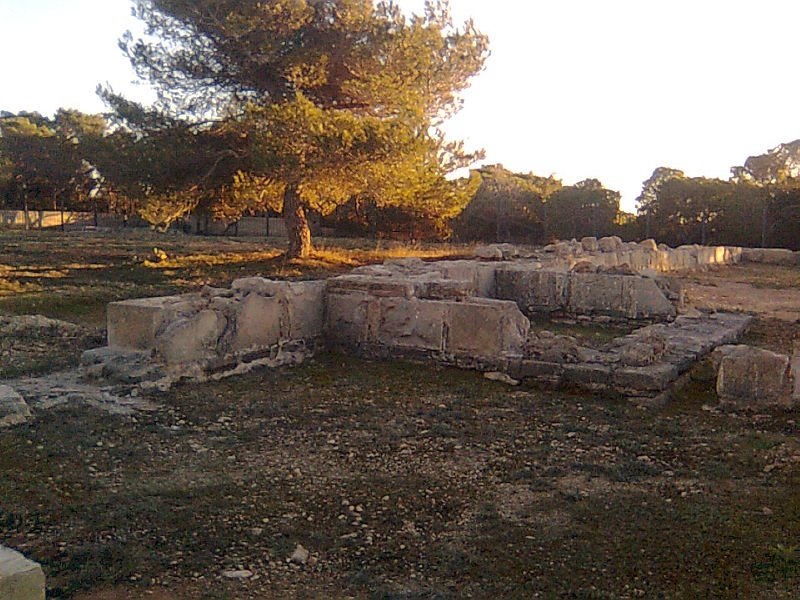
The archaeological jewel of the Roman era in Formentera is the Can Blai site, an imposing military fortification from the Late Empire (3rd–5th centuries AD) located in the center of the island. Archaeologists describe it as a castellum—a watch fort—whose rectangular layout with five towers has been compared to similar structures found in Syria, Tunisia, and Palestine.
The Roman name for the island was Frumentaria, from the Latin frumentum (wheat). The Romans also exploited the natural salt flats and used the island as a strategic point to control imperial maritime trade routes.
After the fall of the Empire (476 AD), Formentera was exposed to Vandal attacks and was progressively abandoned, beginning a cycle of depopulation that would repeat itself for centuries.
📷 Castellum of Can Blai · Wikimedia Commons · Public domain
In the year 902, the Caliph of Córdoba definitively conquered the Balearics. Under Arab rule, Formentera was known as Yabisa al-Saghira (Little Ibiza) and was part of the flourishing Islamic Mediterranean trade. The salt of Formentera was especially appreciated and exported to North Africa.
The Arab geographer al-Idrisi described the islands in the 12th century as fertile and well-governed territories, with salt flats whose production "never ended." The Arab era was one of the periods of greatest relative prosperity for the Pityusic Islands, connected to the trade routes between Al-Andalus and the eastern Mediterranean.
Many place names in the Balearics have Arabic origins. This cultural heritage coexisted for centuries alongside subsequent Christian colonization.
In 1235, Guillem de Montgrí—sent by King James I the Conqueror—took Ibiza and Formentera for the Crown of Aragon. Arab resistance was limited and the islands fell into Christian hands relatively quickly. The salt flats were immediately distributed among the nobles participating in the campaign.
The island became part of the newly created Kingdom of Mallorca. In 1336, the Romanesque chapel of Sa Tanca Vella was built in Sant Francesc Xavier, one of the most eloquent testimonies of the medieval period. However, the tranquility would not last long: the 14th century would bring the Black Death (1348) and the start of pirate attacks that would condition Formentera’s history for four centuries.
The four centuries following the reconquest were marked by the terror of the Barbary pirates from North Africa. These attackers not only looted goods: they captured people to enslave them and sell them in Islamic Mediterranean markets. The threat was so constant that Formentera was practically depopulated on several occasions.
The Black Death of 1348 decimated the already sparse population. Attempts to repopulate the island failed repeatedly: a small group would barely settle when a new raid forced them to abandon it. The coastal watchtowers that can still be seen on the island are direct witnesses to this era: they served to warn of the arrival of pirates and give time to flee.
During much of the 15th, 16th, and 17th centuries, Formentera was de facto depopulated, inhabited only by seasonal fishermen and smugglers.
Salt has been Formentera’s most important economic resource for centuries. The first documented mentions date from the 12th century, when the Arab geographer al-Idrisi described the abundant salt flats of the Pityusic Islands. When Guillem de Montgrí conquered the island in 1235, the salt flats were already actively producing and their profits were one of the main reasons for the seigniorial distribution.
The great industrial leap came in 1878 with the founding of the Saline Factory of Ibiza. Rails were built on which steam locomotives ran, transporting salt from the ponds to the port of La Savina. Most of the island’s male population found employment in the salt flats for decades.
The salt flats closed in 1985. In 1995 they were declared a Nature Reserve and in 1999 they obtained recognition as a UNESCO World Heritage Site. Today they host flamingos, yellow-legged gulls, and numerous migratory birds in one of the most spectacular natural settings in the Mediterranean.
📷 Les Salines de Formentera · Wikimedia Commons · CC BY-SA 4.0
The coup d'état of July 18, 1936 plunged Spain into a civil war. The Balearics quickly fell under Francoist control. Formentera, subordinate to Ibiza, came under the regime from the first days of the uprising. The repression was brutal: republicans, unionists, and people considered "disaffected" were arrested, judged by summary military tribunals, and sent to prison.
During the nearly forty years of dictatorship (1939–1975), life in Formentera was marked by economic autarky, the prohibition of Catalan in public spaces, and the dominant role of the Catholic Church. The economy continued to be based on agriculture and salt flats, with widespread poverty. However, the tourist opening in the 60s—paradoxically promoted by the regime itself to obtain foreign currency—would change the island forever.
One of the darkest chapters in Formentera’s history is the Penitentiary Colony of Es Campament (1940–1942), next to the port of La Savina. This camp for republican prisoners was built by the prisoners themselves and housed between 1,100 and 1,400 people simultaneously in subhuman conditions.
"The prisoners died of starvation because the food they were entitled to was sold by the officials. There are testimonies of prisoners rummaging through waste to find something edible."
— Antoni Ferrer Abárzuza, historian, Second Plan of Mass Graves of the Balearic GovernmentThroughout its two years of operation, about 2,000 people passed through the colony, arriving from all over Spain. 58 prisoners died of hunger and disease. Among them was documented the case of a teenager of only 14 years old, Manuel Díaz Sauceda, from Don Benito (Badajoz).
The camp closed in November 1942. Today, its ruins are a Property of Cultural Interest. In 2022, exhumations began to identify the 58 deceased and return their remains to their families. The British Royal Air Force photographed the camp in 1941 and 1942; those historical aerial images are the main graphic evidence of its existence.
📷 Ruins of Es Campament · Fòrum per a la Memòria d'Eivissa i Formentera
The second half of the 20th century transformed Formentera radically. In the 1950s, the first tourists arrived attracted by the pristine nature and the waters of Ses Illetes—among the clearest in Europe—and by an atmosphere of freedom that geographic isolation provided.
Access was complicated: there was only a small boat from Ibiza, the legendary Joven Dolores. Hotel infrastructure was practically non-existent, which paradoxically made the island more attractive to those seeking authenticity. Tourism took off strongly in the 70s, consolidating itself in the following decades.
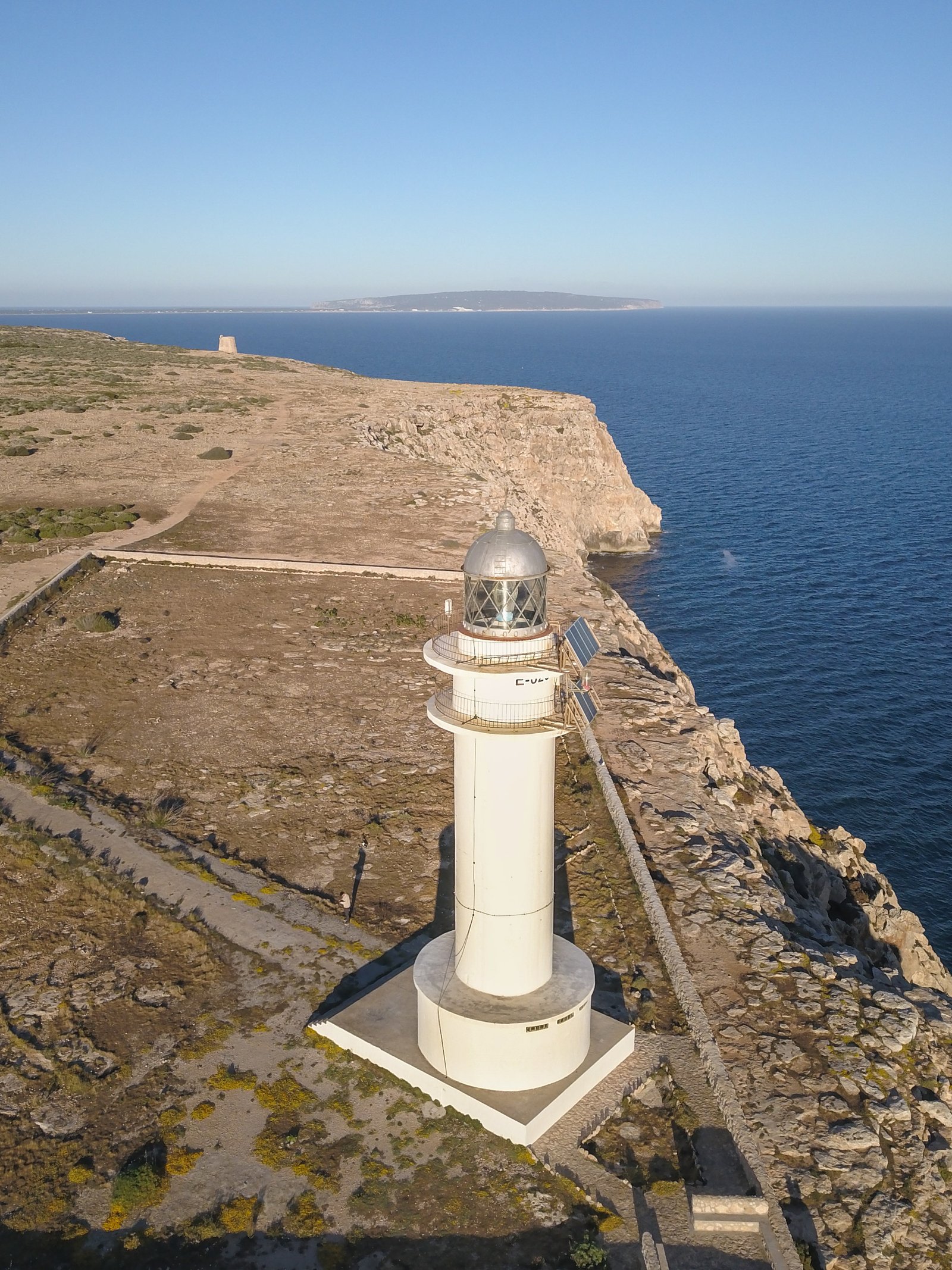
Today Formentera receives between 700,000 and 900,000 visitors a year on an island of 12,000 inhabitants. The island has established pioneering sustainable tourism measures: limits on the number of cars, protected marine zones, and construction restrictions. In 2007 it obtained its own Consell Insular (Island Council), independent from Ibiza.
📷 Cap de Barbaria Lighthouse · Wikimedia Commons · CC BY-SA 3.0
In the mid-60s, hundreds of young people from all over the world arrived in Formentera looking for what the island had in abundance: pristine nature, absolute tranquility, and freedom. In the midst of the Vietnam War, many Americans who rejected military service crossed the Atlantic and found their Mediterranean utopia in Formentera.
The main hippie community formed in Es Molí, in La Mola. The headquarters was the Fonda Pepe in Sant Ferran, where artists, musicians, and adventurers from all over the world gathered to debate, create, and live. That legendary tavern is still open today and is a mandatory stop for any traveler wanting to connect with the island’s spirit.
The Franco regime reacted with repression: between 1968 and 1970 there were raids and expulsions of hippies accused of "public scandal" and drug use. Many returned season after season. Over time, the introduction of hard drugs and the democratic transition marked the decline of the movement. Its legacy persists in the La Mola craft market and the Flower Power summer parties.
The connection between Formentera and the music of the 60s and 70s is so deep that the island literally has its own soundtracks composed by some of the most important rock bands in history.
The band recorded the soundtrack for the film More at the Molí d'en Teuet in Sant Ferran. «Green is the Colour» is considered a direct tribute to the island’s landscape. The album triggered hippie tourism in the Pityusic Islands.
The nearly ten-minute track from the album Islands, written by Peter Sinfield, is a dreamlike evocation of the island with flutes and Mediterranean harmonies. The unofficial anthem of Formentera.
The Catalan singer-songwriter settled in the hippie community of La Mola. His album Jo, la donya i el gripau incorporates the experiences of Formentera and became a cult object of the Spanish alternative scene.
Other artists linked to the island include James Taylor, Taj Mahal, Dexter Gordon, and Gilberto Gil. According to legend—without definitive documentary proof—Bob Dylan also spent several seasons in Formentera.
«More» (Barbet Schroeder, 1969) is the first major film linked to Formentera. Shot partly at the Molí d'en Teuet in Sant Ferran and set to a Pink Floyd soundtrack, it tells the story of a hippie's descent into hard drugs. It was heavily censored in several countries and became a cult classic.
«Sex and Lucia» (Julio Medem, 2001) features probably the most famous scene of Spanish cinema shot on the island: Paz Vega pedaling along the road to the Cap de Barbaria lighthouse with the wind rumpling her red dress. The film turned Formentera into a cinematic icon and the lighthouse into a pilgrimage destination. Cala Saona and the Blue Bar also appear in this story of love and desire that Medem filmed with a narrative freedom that perfectly matched the island's spirit.
«Formentera Lady» (Pau Durà, 2018), starring José Sacristán, looks back at the hippies of the 70s and is a piece of sentimental memory about an unrepeatable era. The RTVE documentary «Formentera, between heaven and earth» (2022) offers a breathtaking aerial journey from the salt flats to the cliffs of La Mola.
Directed by Carmelo Convalia. Tells the complete history of the Formentera salt flats, from their medieval origins to their closure in 1985 and the struggle for their conservation. Includes testimonies from the last salt workers and music by Aires Formenterencs.
Directed by Carmelo Convalia and produced by Formedia Producciones. Explores the harsh events during the Spanish Civil War in Formentera (1913-1975), including testimonies about the famous Es Campament prison camp in La Savina.